Scribe v2 Medical is now available to everyone
- Written by
- Min Kim
- Published
ListenListen to this article
Clinical audio is one of the hardest tests for accurate speech recognition. Drug names are long, rare, and easy to mix up (hydroxyzine and hydralazine are one misheard syllable apart). Vocabulary is dense, with dosages, units, anatomy, and pathology terms that can arrive in rapid sequence. The stakes are also higher because a transcription error could end up impacting a patient's care.
That’s why ElevenLabs is today releasing Scribe v2 Medical, our Speech to Text model fine-tuned for clinical audio, which is now generally available on ElevenAPI. In ElevenLabs testing, it achieves the lowest word error rate (WER) on medical ASR benchmarks, and reduces WER on clinical audio by 18% compared to our base Scribe v2 model.
General purpose models are great at handling everyday speech, but degrade where clinical workflows need them the most. We trained a medical fine-tune of Scribe v2 focused on medication names along with clinical dictation, on public benchmarks anyone can reproduce.
Scribe v2 Medical is the clear choice for clinical use cases
Eka Medical ASR benchmark
In internal tests, Scribe v2 Medical achieves a lower WER in ElevenLabs testing than every result published on the Eka Medical ASR benchmark. The evaluation dataset contains 3,619 English clinical audio samples — across isolated drug and condition names, clinical sentences, and conversations between clinicians and patients — with per-term annotations and a published leaderboard on the dataset card.
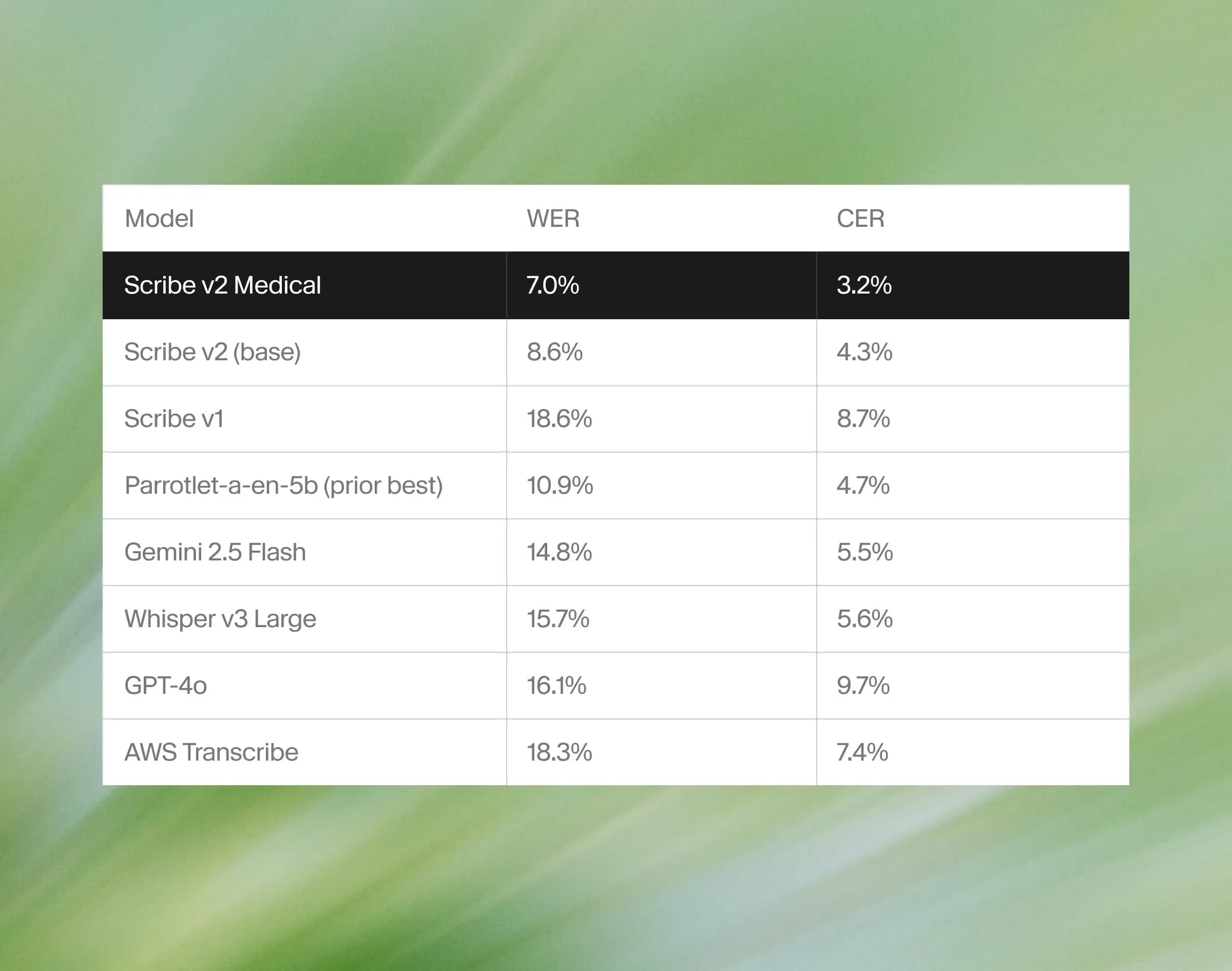
Scribe v2 Medical reduces WER by 1.6 percentage points (pp) compared to base Scribe v2, from 8.6% to 7.0%. To assess whether these results were statistically significant, we rebuilt the benchmark 10,000 times, each time drawing a different random mix of the same 3,619 clips, and re-scored both models on every rebuild. If the improvement depended on a lucky handful of recordings, the rebuilds that happened to leave those recordings out could have flipped the winner. None did, and the medical model came out ahead in all 10,000, with the improvement estimated between 1.3 and 1.9 pp (95% confidence interval).
Omi Health Medical Speech to Text benchmark
Performance is evidenced beyond a single benchmark. Omi Health maintains a public leaderboard of 30 speech to text systems scored on 1,513 clinical English clips (7.2 hours across 57 consultations).
Omi evaluated Scribe v2 Medical directly on this benchmark. It records the lowest overall WER of all 30 systems tested (5.88%) and substantially improves dosage accuracy over base Scribe v2 (86.2% vs. 79.8%).
Omi's benchmark updates with the Scribe v2 Medical results on September 25, and the figures above are shared with their permission ahead of that update.
Customers in production
Customers are already using Scribe v2 Medical in production and seeing improvements in clinical audio.
"Since switching from Deepgram to ElevenLabs Scribe v2 Medical, we're seeing much higher accuracy on clinical terminology, and that changed how the team work,” said Mendel Erlenwein, CEO and founder of CareCo. “When our coordinators trust transcripts, they can spend less time correcting notes and more time on the phone with patients. Our patients are on complicated regimens, and the note the care team reads has to be right.”
Improvements that matter the most
WER on a full transcript can sometimes mask what matters the most in a clinical setting, because even clinical conversations are primarily composed of ordinary speech. Eka annotates the medical terms in each sample, so it’s possible to score on those terms alone. On medical term-only WER, Scribe v2 Medical makes 14% fewer errors than base (9.5% vs. 11.1%), and the gains are largest where terms appear inside full sentences (7.5% vs. 9.9%).

A caveat from the same data is that isolated single-word clips (a lone drug name spoken with no surrounding context) remain the hardest case for every model on the leaderboard, including Scribe v2 Medical. It scored 14.3% WER on isolated terms compared to 7.5% when those terms appear in sentences. With zero context, a misheard syllable can result in memorable failures:
- etodolac (an NSAID) → "It'll do the luck"
- levomilnacipran (an antidepressant) → "Leave me alone now, Sephora."
- methdilazine (an antihistamine) → "Let's play our scene."
One way to reduce these errors is with keyterm prompting, which lets you highlight drug names or medical phrases to bias the model towards successfully transcribing them.
Beyond the headline benchmark
The accuracy of v2 Medical holds true beyond just the English language.
On Corti’s MedDictate benchmark, a public clinical dictation dataset, Scribe v2 Medical reduces WER by roughly 36% relative to the base Scribe v2 model, and the improvement holds in all three languages:
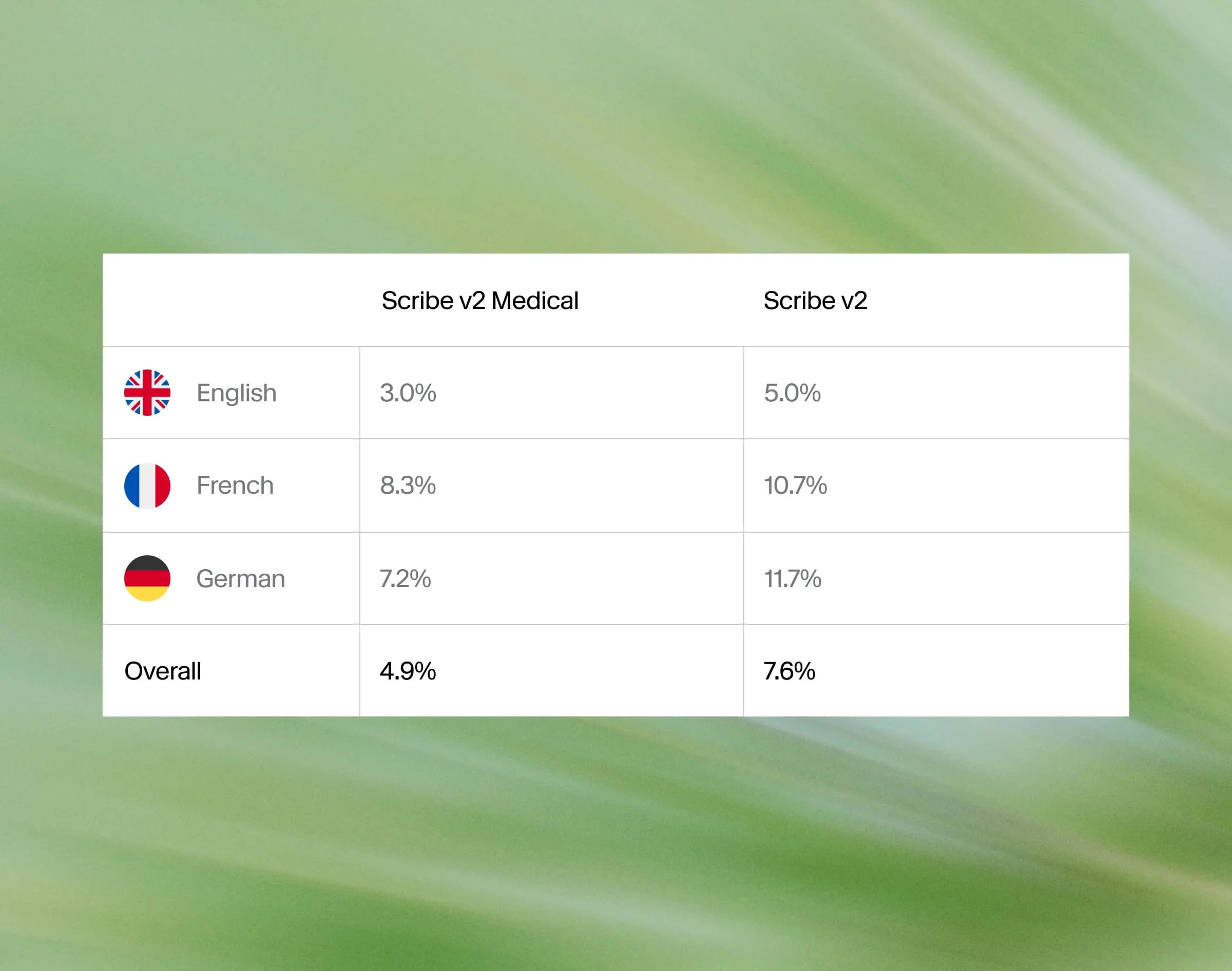
The team also verified that the medical fine-tune does not degrade performance in other areas. On 6,000 samples of everyday, non-medical speech derived from CommonVoice, Scribe v2 Medical scores the same as base Scribe v2 when rounded, a 5.3% WER in both cases. So with v2 Medical, you get the benefits of a specialized medical model — without giving up accuracy on this benchmark.
Built for protected health information
Scribe v2 Medical is HIPAA-eligible for enterprise customers with Business Associate Agreements (BAA) in place and Zero Retention Mode (ZRM) enabled.
With ZRM enabled for Speech to Text API requests, audio input and text output are deleted immediately after each request completes. ElevenLabs retains neither, and your application receives the full API response and controls how transcripts are retained.
Getting started
Scribe v2 Medical is available on the Speech to Text API. Simply pass the new model id: scribe_v2_medical
The model runs on the batch Speech to Text endpoint.