What is prosody and how does it shape spoken language?
- Written by
- Jack Limebear
- Published
- Last updated
ListenListen to this article
Prosody is the rhythm, stress, and intonation of speech, the patterns that give our words meaning beyond their literal definitions. How high or low our voice is, how fast we talk, and where we accent our words all contribute to how language is communicated and understood.
Previously used only to describe human speech, prosody is now becoming just as relevant to the AI voice tools built to generate it. It plays a major role in whether AI feels human, moving beyond getting the right words in the right order to adding the small inflections that convey meaning. This is especially true in settings like customer service or audio narration, where a word said in the wrong way can undercut the entire message.
This article defines what prosody is, provides examples, and covers its importance in Text to Speech (TTS) models, so you understand what it takes to make AI sound and feel more human.
Summary
- Prosody in reading reflects a reader's understanding of a text and helps build fluency.
- Prosody is what allows Text to Speech models to turn plain text into natural, human-sounding audio.
- Prosody can be added to AI voices through tools like voice selection, audio tags, and punctuation.
What is prosody?
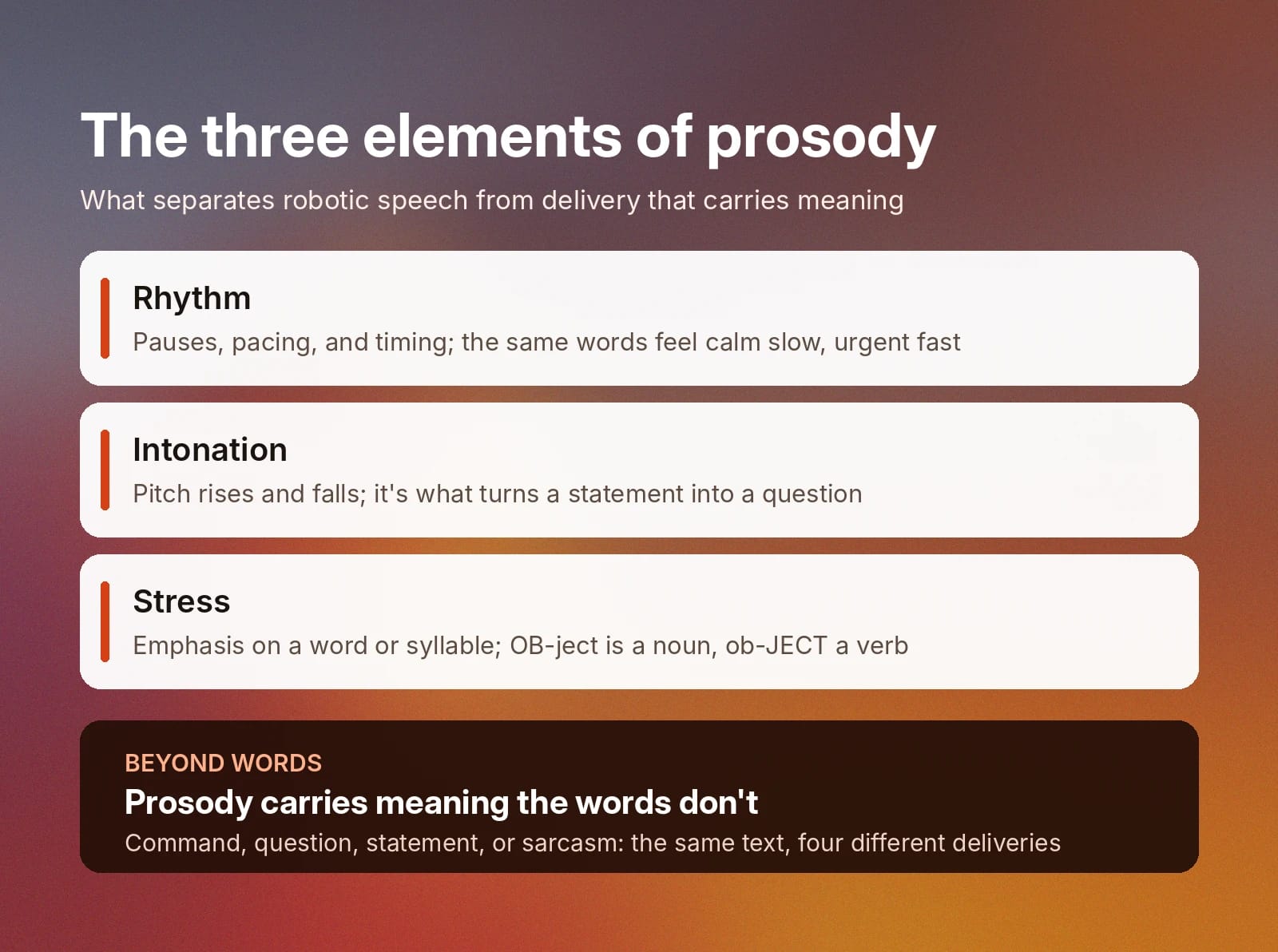
Prosody refers to the pitch, timing, and emphasis patterns in speech. This includes the way something sounds (like phonemes) as well as the emotional sentiment behind the words, such as whether you’re speaking a command, question, or statement, or being sarcastic.
When evaluating prosody, we typically look at three elements:
- Rhythm: How the timing and pace of speech create patterns.
- Intonation: How pitch rises and falls across a sentence.
- Stress: How specific words or syllables are emphasized through pitch, loudness, or duration.
Being able to control these three elements is what separates robotic speech from delivery that conveys meaning beyond the words themselves.
Understanding prosody in speech: Rhythm, intonation, and stress
Although they may seem simple, a lot goes into rhythm, intonation, and stress to convey the feelings behind our words.
Here is a closer look at how these three core elements impact speech.
Rhythm
Rhythm shapes the pauses, pacing, and timing that give speech its structure. Romance languages like French and Spanish tend to give equal time to every syllable, while English and German have more variance in the timing and pace of words.
Rhythm can also change how a sentence lands. Saying “We are on the way” slowly and evenly makes the phrase sound reassuring. Said quickly, and the same words feel packed together, creating a sense of urgency.
Calm vs. urgent through rhythm

Intonation
Intonation refers to how pitch rises and falls. Often, it’s what distinguishes between a question and a statement.
Take this sentence: “Jim won the game.” When ending in a period, “game” is said at the same pitch as the rest of the words. But to indicate it’s a question (“Jim won the game?”), your pitch would rise at the end.
It can also express emotions. An enthusiastic “Hello!” will have a different pitch than a disappointed or disinterested “Hello.”
Jim won the game vs. Jim won the game?

Stress
Stress refers to how a word or part of a word is emphasized.
The word “object,” for example, has two meanings. With the accent on the front half (“OB-ject”), a speaker is referring to the noun. Accenting the back half (“ob-JECT”), meanwhile, turns it into the verb.
In a sentence, stress brings focus to a word. Emphasizing “I” in “I saw Jim at the game” tells the listener that it’s important to know who saw Jim at the game. On the other hand, emphasizing “game” points the listener to where they saw Jim.
How does prosody affect reading?
Prosody in reading provides context for words. Think of it like how you read a story aloud to a child: Without using voices and varying tones, the child would have a harder time deciphering what a character is feeling or what a scene expresses.
Prosody is also a reliable indicator of reading fluency. People fluent in a language can take written words and add prosodic emphasis, showing they grasp not just what the words mean, but the meaning behind them that isn't written on the page.
Overall, prosody improves literacy and language fluency by providing context for words and phrases, and it decreases miscommunication by connecting the meaning of words to the audience or scenario in which they're spoken.
Why is prosody important for Text to Speech models?
The words a Text to Speech model turns into audio, whether pulled from a script or generated by an LLM, start as plain text. Those words might be exactly right, but text alone doesn't carry tone, emphasis, or feeling.
Think about a classic IVR bot telling you, “I’m sorry. I didn’t understand that.” This line is typically delivered with flat prosody, so most listeners aren’t going to feel that the bot is actually sorry for the inconvenience it’s causing.
Compare this scenario to an AI voice agent being used to handle a frustrated customer who has had his flight canceled.

The response feels human when the AI agent says, “I hear you, and I’m so sorry about that,” because the response is not one-note. It includes a slight groan, a pause at the beginning, and a low tone, all of which convey an apology just as much as the words do.
By getting these prosodic elements correct, the agent can de-escalate a tense moment instead of adding to the frustration.
Text to Speech models power more than AI agents. They're also behind ElevenCreative's tools for voiceovers, narration, and marketing content. An AI voice that uses prosody correctly can help you with:
- Voiceovers: Produce ads, explainer videos, and social content that sound genuinely engaging.
- Audiobooks: Narrate with the right emotional shading, so a character's fear, joy, or sarcasm comes through the way a human narrator would deliver it.
- Localization: Preserve the emotional intent of the original content across languages.
- Marketing and brand messaging: Keep audio on-tone, avoiding delivery that sounds solemn when it should be upbeat, or vice versa.
Prosody makes all of this possible. Next, let's look at how Text to Speech models actually produce it.
How TTS models generate prosody
Today's neural Text to Speech models (neural TTS) generate prosody through deep learning models trained on actual human speech. Rather than following hand-written phonetic rules, the model learns the relationship between text and how it actually sounds when spoken aloud.
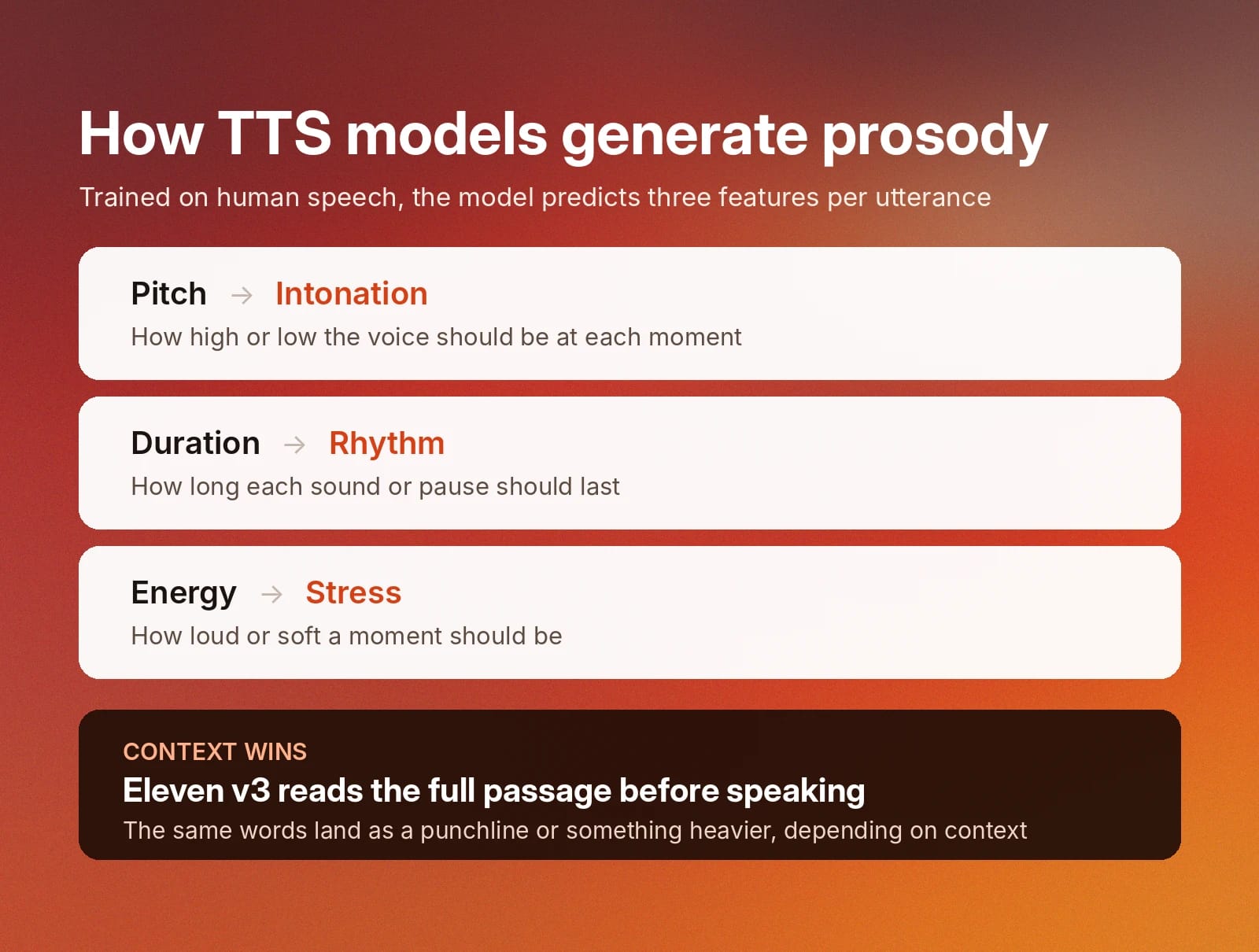
That training process allows the TTS model to predict three features across an utterance:
- Pitch: How high or low the voice should be, which produces intonation.
- Duration: How long each sound or pause should last, which produces rhythm.
- Energy: How loud or soft a moment should be, which produces stress and emphasis.
For example, a model trained on thousands of hours of human speech will have heard countless questions expressing incredulity, like "Wait, you did what?" delivered with a sharp rise in pitch and a burst of energy on the final word. It learns that pattern through repeated exposure and applies the same delivery the next time it encounters a phrase expressing the same kind of disbelief.
However, how much context a model can draw on when generating that delivery also depends on the architecture doing the predicting.
Older TTS models worked through a pipeline, processing text one sentence at a time and passing predictions between separate networks before producing audio. Newer, transformer-based models collapse that pipeline into a single end-to-end process.
Instead of reading one sentence in isolation, the model reads the entire passage first, then uses that wider context to decide how a line should sound. The same words can land as a punchline or as something much heavier, depending on what surrounds them.
Models such as Eleven v3 read the full passage before generating audio to ensure the delivery reflects the context of the surrounding text.
How users control prosody in TTS
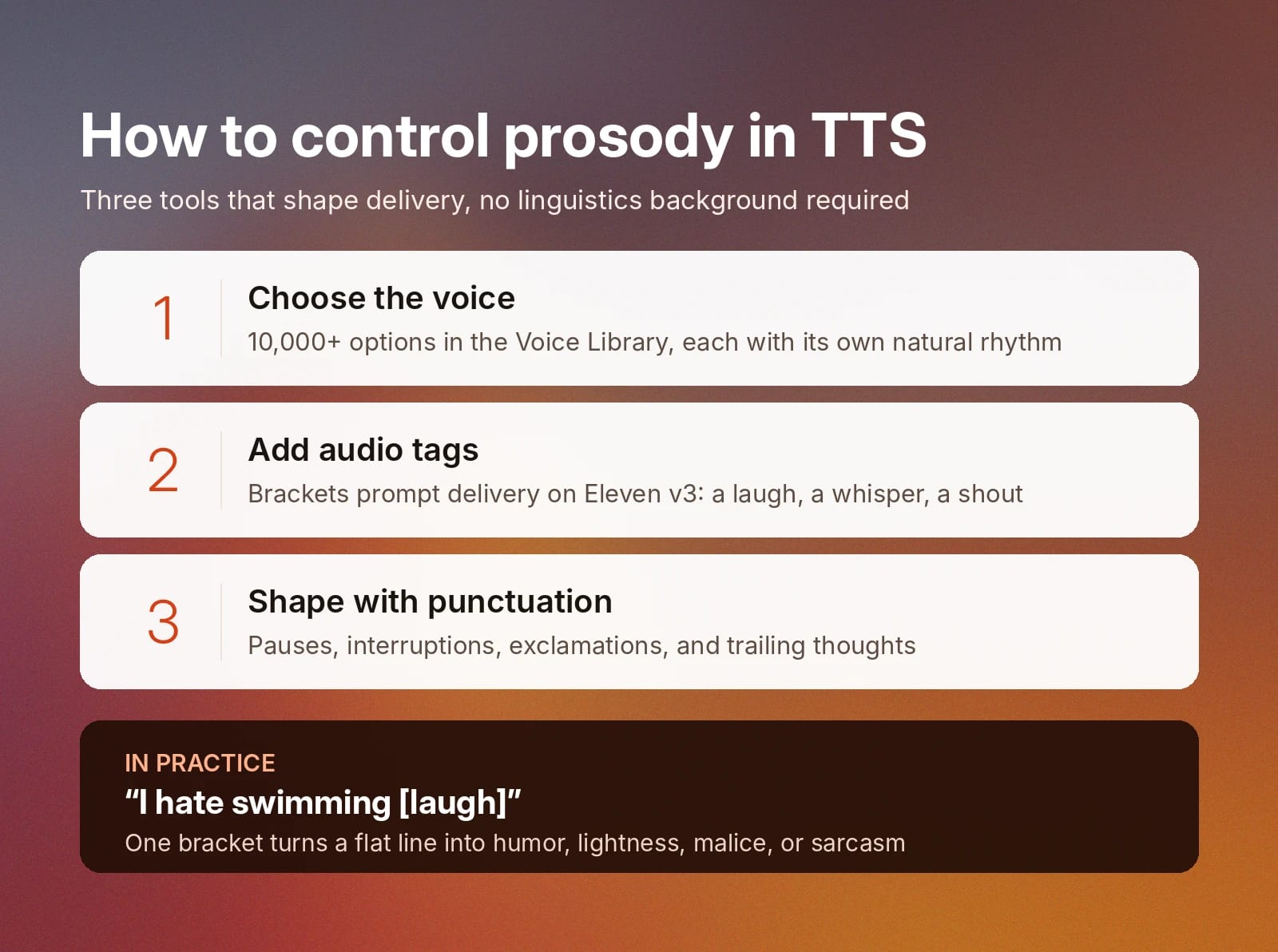
Users can control prosody in TTS by choosing unique AI voices and inserting emotional tags into scripts. ElevenCreative, for example, gives you access to the Voice Library, where you can choose from 10,000+ voices to find the one that has the natural rhythm and intonation you’re looking for.
Eleven v3, our most expressive TTS model, also gives you the option to add audio tags via brackets to text, prompting a specific prosody element for the model to deliver. Maybe you want to inject a laugh between sentences to show humor, lightness, malice, or sarcasm, or have the voice model whisper or shout a word for emphasis. Punctuation, too, can create pauses, interruptions, exclamations, questioning, or trailing voice elements.
Here’s what that might look like:
- “[laughing] I hate swimming.”
- “[surprised] I can’t believe he did that! [chuckles] I’m shocked…and impressed.”
- “[annoyed] Don’t do that!"
Let's see those in action:
Together, these tools mean you don't need a background in linguistics or audio production to control prosody. Anyone can shape how an AI voice sounds, just by choosing a voice, adding a tag, or adjusting punctuation.
Enhance expressive AI voices with ElevenCreative
Whether you’re running ads, posting on social media, or creating videos, you want them to sound like a real person made and voiced them.
ElevenCreative enables you to generate audio and visuals at scale in minutes. Its AI-native platform can turn written text into human-like speech that’s tailored to the context, emotion, and intent of the speaker. And with over 70 languages available with Eleven v3, plus a vast library of voices, you can be confident you’re setting the right tone with your audience.
Discover more about TTS on ElevenCreative or sign up to get started and see how AI voice with natural prosody can transform your content.