

Topic discovery
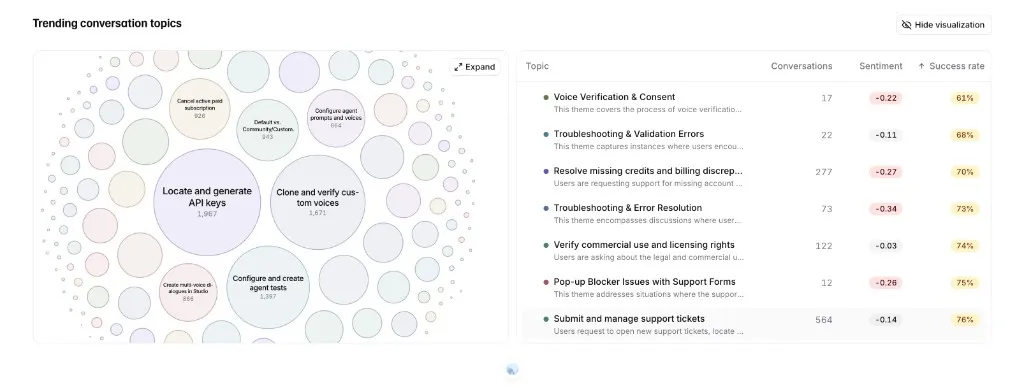
Topic discovery groups completed agent conversations into recurring topics.
Use it to understand what users discuss with your agents, how those topics change over time, and which conversations contributed to each topic.
Overview
Topic discovery helps you answer questions such as:
- Which topics are users discussing most often?
- Which topics have positive or negative sentiment?
- Which topics are succeeding or failing against your configured evaluation criteria?
- Which conversations contributed to a topic?
Enable topic discovery
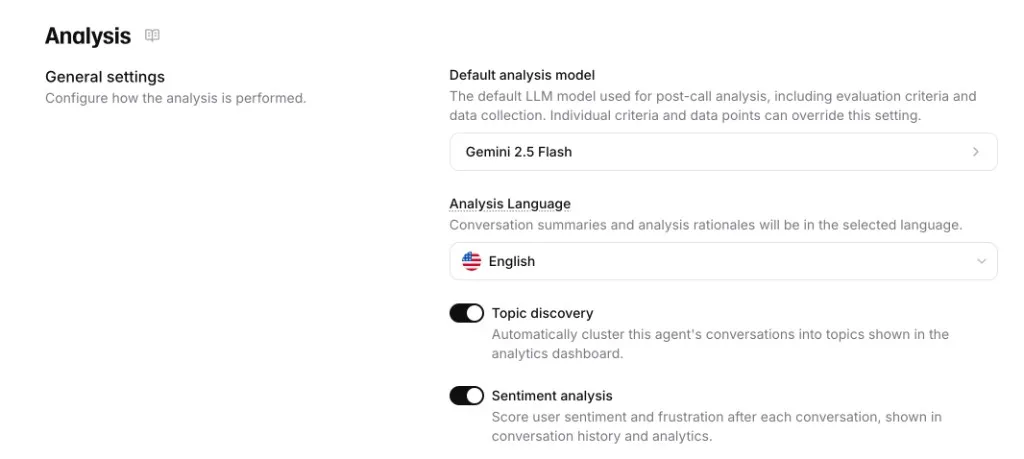
To enable topic discovery, open your agent’s Analysis settings and turn on Topic discovery.
The same settings page also includes Sentiment analysis, which adds sentiment metrics to conversations and discovered topics.
How topic discovery works
Topic discovery runs after conversations are analyzed. It reviews conversation transcripts for an agent and groups conversations with similar meaning into topics.
Each topic represents a recurring user intent or issue, such as billing questions, booking changes, product availability, or short non-engaged calls.
Conversation analysis runs
After a conversation ends, the platform analyzes the transcript and stores the conversation-level results.
Topic metrics
Topic metrics are calculated from the conversations assigned to each topic.
- Conversations: Number of conversations assigned to the topic in the selected time window.
- Sentiment: Aggregate user sentiment for the conversations in the topic.
- Success rate: Percentage of evaluated conversations that passed your configured success criteria.
Success rate depends on Success evaluation. If no success criteria are configured, the topic can still appear, but success rate may be unavailable.
Sentiment
Sentiment is aggregated from conversation-level sentiment analysis. It helps you identify topics where users are usually positive, neutral, or negative.
Use sentiment to prioritize topics that combine high volume with negative user experience.
Success rate
Success rate is calculated from Success evaluation results.
The rate uses conversations with a success or failure result. Conversations with an unknown result are not counted in the success rate because the platform could not determine whether the criterion passed.
Time windows
Spotlight aggregates topics over the selected time window.
Short windows help you inspect recent changes. Longer windows help you identify recurring patterns and higher-confidence trends.
When you change the time window, the same topic can show different volume, sentiment, and success rate because the underlying conversation set changes.
Conversation drill-down
Select a topic to open the conversations assigned to it.
Use drill-down to:
- Review real examples behind a metric.
- Understand why a topic has negative sentiment.
- Find conversations that failed an evaluation criterion.
- Identify missing knowledge base content or prompt instructions.
Review a few conversations before changing your agent. Topic-level metrics show the pattern; conversations explain the cause.
Historical data
Topic discovery updates automatically for new conversations after it is enabled.
Historical conversations only show complete topic metrics if the required analysis results already exist for those conversations. For example:
- Sentiment requires conversation-level sentiment analysis.
- Success rate requires success evaluation results.
- Topic drill-down requires conversations to be linked to the discovered topic.
If older conversations show topics without sentiment or success rate, the underlying historical analysis may not have been generated for that period.
Best practices
Start with clear evaluation criteria
Configure success criteria that match the actual goal of the conversation. Vague criteria make topic success rates harder to interpret.
Use topic volume and sentiment together
High-volume topics with negative sentiment usually deserve review before low-volume topics with similar sentiment.
Compare time windows
Use short windows for recent regressions and longer windows for stable product or support trends.
Use drill-down before changing prompts
A topic can contain several user situations. Review example conversations before changing the system prompt, tools, or knowledge base.