Voice agent capabilities: Memory, escalation, and more
- Written by
- Jack Limebear
- Published
ListenListen to this article
Traditional phone systems relied on scripted, menu-driven responses. This limited their ability to adapt to natural speech or handle complex workflow requests. Today's voice agent capabilities have moved well beyond that by uniting real-time speech recognition, reasoning, and context into more responsive speech systems.
Modern voice agents can authenticate a customer, source their information within the system, provide reasonable responses with live data, recognize when the situation needs to be handed over, and more. All of this happens during a live call, without sending the user through a phone queue to wait for a live agent.
This guide answers six questions about AI voice agent capabilities: how they remember callers, how they handle frustration, what data trains them, how they personalize, how they protect sensitive data, and what they do to CSAT. Each answer describes how ElevenAgents does it in practice.

Summary:
- Voice agents pair real-time speech recognition with reasoning over live data, letting them authenticate callers, answer with current information, and complete tasks during a call without routing anyone through a phone queue.
- Agent memory works within a single call and across repeat interactions, pulling customer history from a CRM at the start through dynamic variables and logging outcomes back through post-call webhooks.
- Frustrated callers are managed with sentiment detection and real-time de-escalation, with a transfer path to a human or specialized agent when frustration crosses a threshold or the caller asks for a person.
- Agents build knowledge from uploaded content in formats including PDF, Word, text, Markdown, HTML, and EPUB, using RAG to retrieve relevant passages while smaller documents stay in full context.
- Personalized recommendations combine CRM data, the live request, and mid-call product lookups through tool calling, so the agent matches real availability against the caller's history.
- Configurable privacy settings govern data retention, audio storage, transcript redaction, and zero-retention mode, with HIPAA eligibility for enterprise healthcare deployments.
What are voice agent capabilities?
A voice agent is an artificial intelligence (AI) system that can hold real-time spoken conversations with customers. This goes beyond traditional voice capabilities by understanding intent, the context of the situation, and completing tasks on the customer's behalf. These agents work by listening to the customer, reasoning with what they hear, referencing the systems they need to complete the request, and then speaking to the customer in a natural tone similar to a human customer service agent.
When defining voice agent capabilities, these are the specific functions that make conversations between the agent and the customer useful. These functions can be broken down into several categories to determine how well it will perform in that role:
- Memory and context: The ability to retain information about a customer across a single call or multiple interactions with the same customer.
- Handling difficult scenarios and conversations: Agents stay on topic and follow policies when a caller is frustrated, confused, or unwilling to accept the outcome.
- Training abilities on your content: Agents train from existing internal company documentation and policies to pull responses for the interaction rather than using a generic script.
- Customer personalization: Agents adjust their tone, pacing, or recommendations based on who the caller is, rather than a generic menu of options.
- Data handling: The information shared with agents is managed based on what data is stored, how long the company retains it, and who can access it.
- Measurable outcomes for success: Determining a system that provides internal tracking to better determine if a voice agent is resolving issues and doing so accurately compared to a live agent.
These voice agent capabilities can ultimately help companies better tailor their agents to meet customers' needs.
How do voice agents remember past conversations with customers?
Voice agents do not have built-in memory across calls. Cross-call memory is assembled from three pieces: dynamic variables that inject CRM data at call start, a conversation-initiation webhook that fetches it, and a post-call webhook that writes outcomes back. Within a single call, the agent holds full conversational context automatically.
Depending on your specific architecture, voice agents may handle customer memory at two levels:
- Within a single call: The agent maintains conversational context and tracks everything said within the session, which minimizes the need for the customer to repeat themselves throughout the call.
- Across multiple interactions: This memory is achieved through multi-channel integration. The agent pulls up customer history from the company CRM or database at the beginning of the call, then documents the outcomes from the interaction so the next conversation starts knowledgeable about the history.
Context is injected at the start of the conversation through dynamic variables with ElevenAgents. These variables inject runtime values into the agent’s prompts, messages, and tools. This lets the agent personalize each conversation with user-specific information without building a separate agent for every customer. A caller’s name, account status, identifiable information, and past interaction history can all be passed to the voice agent as the conversation begins.
For inbound telephone calls, ElevenAgents can fetch initial data from company servers through a conversation-initiation webhook, applying the JSON the endpoint returns while the agent loads context. In a live setting, the platform fetches the needed data during the initial customer connection period. This process typically can appear as normal ringing or hold music while the agent reviews the context in parallel.
After the call ends, the flow will run in reverse. The agent does this by sending the call outcomes back to the CRM or support system through post-call webhooks or other call tools. It logs what happened during the call and what may still need to be followed up with the customer. The documentation of the interaction with the customer is what keeps the memory of the voice agent persistent. That way, the next agent or live human that the customer interacts with has the full background before the conversation begins.

How do voice agents handle frustrated or angry customers?
Frustrated and angry customers are bound to happen at any level and in any customer service environment. Voice agents are skilled at handling these types of situations by detecting, adapting, and escalating where needed.
Here is a breakdown of how voice agents are able to navigate difficult situations with customers:
- Detecting frustration: Detecting customer responses works most effectively through sentiment analysis. This analysis scores conversations as positive, negative, or neutral. For individual conversations, sentiment analysis threads each user response along a scored trajectory from negative to positive, so you can see where a conversation went awry. When detection is aggregated across topics, it can reveal which subject areas frustrate callers most and provide data on where to improve. With leading voice agent models, like those available on ElevenLabs, agents can even understand tone from live transcripts and adapt accordingly.
- Adapting in real time: De-escalation behavior can be directly defined in the system prompt for an agent, which allows it to acknowledge the caller’s frustration, avoid arguing with the caller, keep responses on track with the conversation and calm, and lead with a resolution path.
- Escalating to a human: The transfer to number tool hands the call to a human when defined conditions are met, typically when the caller asks for a person, repeats the same complaint twice, or sentiment stays negative for several consecutive turns. Write these conditions into the system prompt. The agent can play a message to the caller while they wait and pass a separate summary to the operator receiving the call, so the person picks up with context rather than starting over. ElevenAgents also supports agent-to-agent transfer, which routes the conversation to a specialized agent when the caller needs different expertise rather than a human.
The most important aspect of voice agent capabilities for handling frustrated customers is the transfer path.

What file formats can be used to train a voice agent?
Modern voice agents aren't trained in the traditional AI/LLM sense. These agents are given knowledge to build on. These voice agents are given documentation, web pages, or plain text resources that refer to a knowledge base, from which the agent then retrieves relevant passages during calls. This approach is called retrieval-augmented generation (RAG). This process lets the agent draw from far more information than one single prompt would provide.
There are several ways to add information to a knowledge base. It starts by uploading a file, directing the agent to a URL, or pasting the text directly. In ElevenAgents, the uploaded files can be up to 20MB each and come in the following formats:
- .docx
- .txt
- .md
- .html
- .epub
Format affects retrieval quality. Markdown, plain text, and DOCX extract cleanly and chunk predictably for RAG. PDFs with multi-column layouts, tables, or scanned pages extract poorly and should be converted before upload.
Once the document is attached, the agent then uses it in one of two ways. Small documents can sit in full context, where the entire document text stays in the prompt on every turn. The second way is to index larger documents for RAG.
In this process, only the passages most relevant to each question are retrieved at the time of the conversation. For example, a document can be used in full context only if its extracted text fits within 250,000 characters. Anything larger than that runs through RAG. This lets the system automatically select the right path once RAG is enabled.

How do voice agents provide personalized product recommendations?
Personalized product recommendations come from combining multiple inputs about the caller at the time of their interaction with the voice agent. These inputs include who the caller is, what they are asking for, and what is available. The agent knows information about the caller from the CRM data passed through dynamic variables.
It also knows the request from the live conversation and what is available by looking at product data through tool calls. The agent will then reason across all of these to recommend personalized options to the caller the same way a well-briefed human representative would do.
To get a better understanding of how this works in a realistic voice agent context, here’s what it looks like on an actual call.
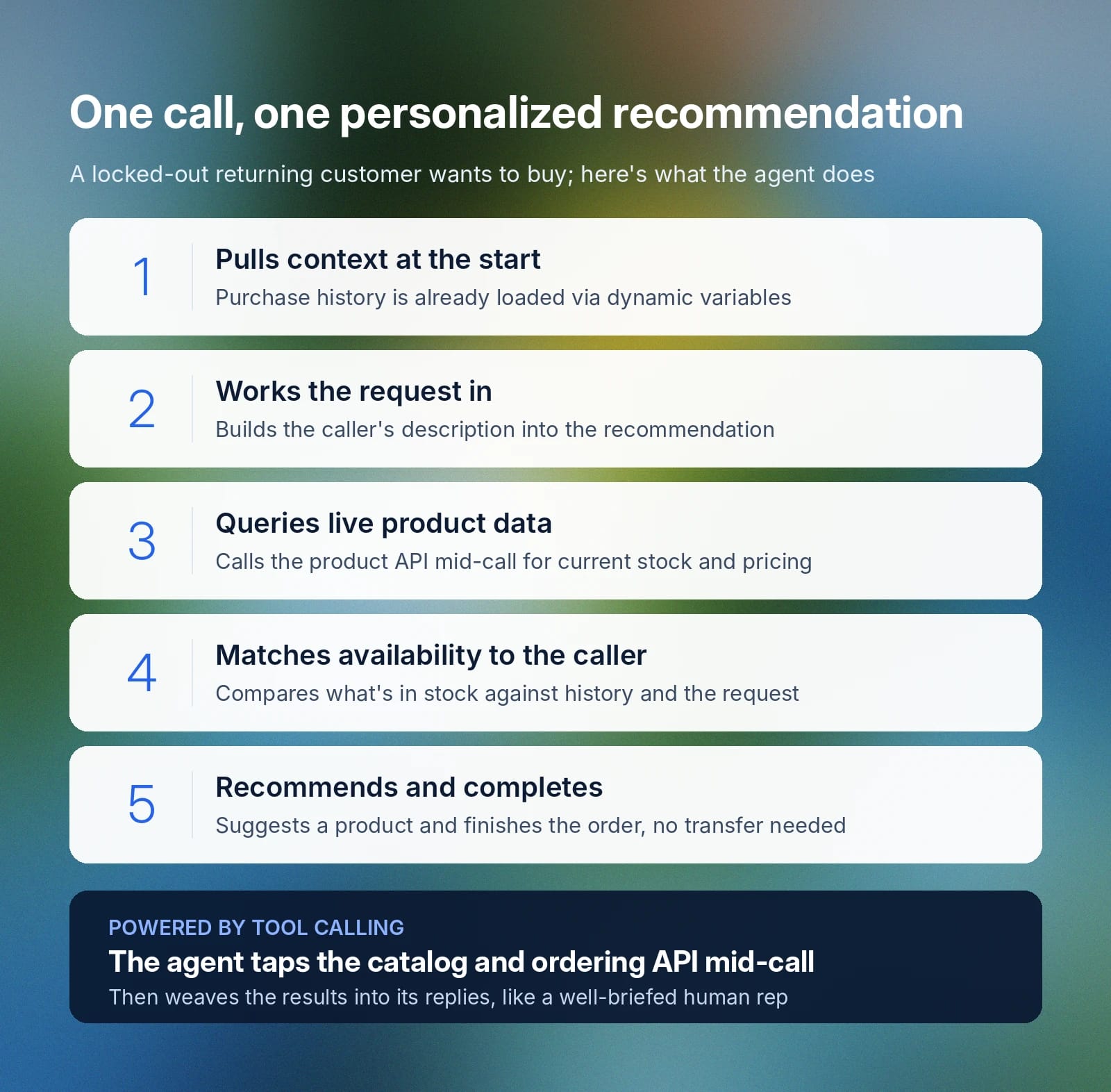
A returning customer calls a retailer's technical support line because they are locked out of their user account and want to make a purchase. Here's how the voice agent turns that call into a personalized recommendation:
- Pulls context at the start: The agent already knows the caller's purchase history and other related information because that was retrieved at the beginning of the call.
- Works the request into the recommendation: The caller describes what they need, and the agent builds that description into its recommendation rather than starting from a blank slate.
- Queries live product data mid-call: The agent calls the product API during the conversation to check current stock levels and pricing, rather than relying on information from training.
- Matches availability to the caller: It compares what is in stock against the caller's description and purchase history.
- Recommends and completes the order: The agent suggests a product and finishes the order on request, without needing to transfer the caller elsewhere.
That whole conversation is powered by tool calling. It's how a voice bot can tap into external systems, like a product catalog or ordering API, and then weave that info into its replies. ElevenLabs' documentation on tools covers how that connection gets configured.
Can voice agents handle sensitive customer data?
Voice agents offer configurable controls for retention periods, the option not to store call audio, conversation history redaction, and strict retention policies for highly regulated industries like healthcare.
With ElevenAgents, each of these controls is configured through privacy settings. Here is a breakdown of how it works:
- Retention: Transcripts of conversations and audio recordings are only stored for a specific time period. ElevenAgents retains transcripts and recordings for two years by default, which can be customized from zero days to unlimited; for HIPAA compliance, a minimum six-year retention is recommended. To ensure full alignment with HIPAA, please keep in mind that actually processing Protected Health Information on our platform requires Zero Retention Mode to be enabled, meaning you would securely store those six years of records on your own infrastructure via webhooks.
- Audio Retention: Call audio recordings can be kept for customer retention purposes or turned off entirely to ensure customer audio is not retained. Disabling audio recordings being saved and setting a retention policy to zero days means that the data is deleted immediately after the call.
- Conversation history redaction: After the conversation has ended, a post-processing step that scans the transcript and audio after each call helps support sensitive customer data through redaction. This step involves scanning the audio and transcript to detect sensitive information, showing a placeholder in the transcripts and an audio bleep in audio snippets. This keeps the conversation history available for review while reducing exposure to sensitive information.
- Zero-Retention Mode: This configuration is best for strict retention requirements. Most data in requests and responses is deleted immediately once the request has been completed. This configuration applies to API traffic and is available to customers at an enterprise level.
For healthcare-related deployments, ElevenAgents is HIPAA-eligible when paired with Business Associate Agreements (BAA) available to enterprise-level customers. When combined with a signed BAA, our Zero Retention Mode is designed to support HIPAA compliance, depending on the customer configuring and using the platform to meet their compliance requirements. Full configuration details for these controls are found in our ElevenLabs privacy documentation.

What customer satisfaction improvements do voice agents offer?
Factors that often lead to improved customer satisfaction include eliminating or reducing hold time, consistency, and faster resolution. Since voice agents can answer calls without delay, callers generally receive a consistent quality of response regardless of the time of day. This leads to a quicker resolution time for routine requests that previously sat in a queue waiting on a live agent.
The caveat to this is that when an interaction with a customer goes wrong, trapping a frustrated customer in an agent loop damages the customer experience quicker than hold music ever did. Many organizations don’t often track their customer satisfaction in isolation. Metrics reported alongside it include containment rate (the rate that the agent resolves a request without human involvement), average handle time, and first-call resolution.
When combined together in a report for review, they often tell a different story than one stand-alone metric. For example, a high containment rate coinciding with a falling customer satisfaction score often signals that calls are being resolved quickly without a human needing to be involved.
Admiral is a good example of prioritizing first-contact resolution over containment. As covered in this webinar, they were targeting a 90% resolution rate alongside providing 24/7 availability and a real NPS lift. A handoff to a human was never counted against the agent, since solving the problem mattered more than keeping the call contained.
Learn more about how this voice agent capability ties into their CRM and voice setup.
Get started the full scope of voice agent capabilities on ElevenAgents
The voice agent capabilities that have been covered in this guide are not separate or stand-alone products. These capabilities should be built into the same agent and configuration, with the right dynamic variables, tools, and privacy settings for the organization's business needs.
Getting started can be as simple as starting with one call type by connecting it to only the systems it will need. From there, the agent can be expanded once the metrics show it is working.
Learn more about ElevenAgents or contact sales to get started today.