What is intent recognition: Understanding user goals in NLP
- Written by
- Jack Limebear
- Published
- Last updated
ListenListen to this article
Every message a user writes, whether to an LLM agent or as an input to Google, has an intent behind it. They’re working toward achieving a goal, be it finding specific information or performing an action.
Intent recognition is the process of identifying what that goal is, mapping out what the user requires based on that goal, and fulfilling the request as accurately as possible. A system with a fine-tuned sense of intent will better serve customers with precise responses, boosting engagement and satisfaction.
In this article, we’ll explore what intent recognition is and explore how intent has evolved in the age of LLM search.
Summary
- Intent recognition is a technique within natural language processing that categorizes the goal of an input.
- To recognize the intent in a conversation, a model goes through four steps: conversation preprocessing, feature extraction, classification, and entity extraction.
- Intent can be informational, transactional, conversational, or navigational when engaging with an LLM.
- Common challenges that researchers consider when fine-tuning intent recognition are linguistic ambiguity, out-of-scope inputs, and multi-intent conversations.
What is intent recognition?
Intent recognition is a technique within natural language processing (NLP) that classifies a spoken or written input based on what the user contextually wants to achieve. That act of classification is also why this technique is sometimes called intent classification, as software has to comprehend input and determine the right course of action to follow.
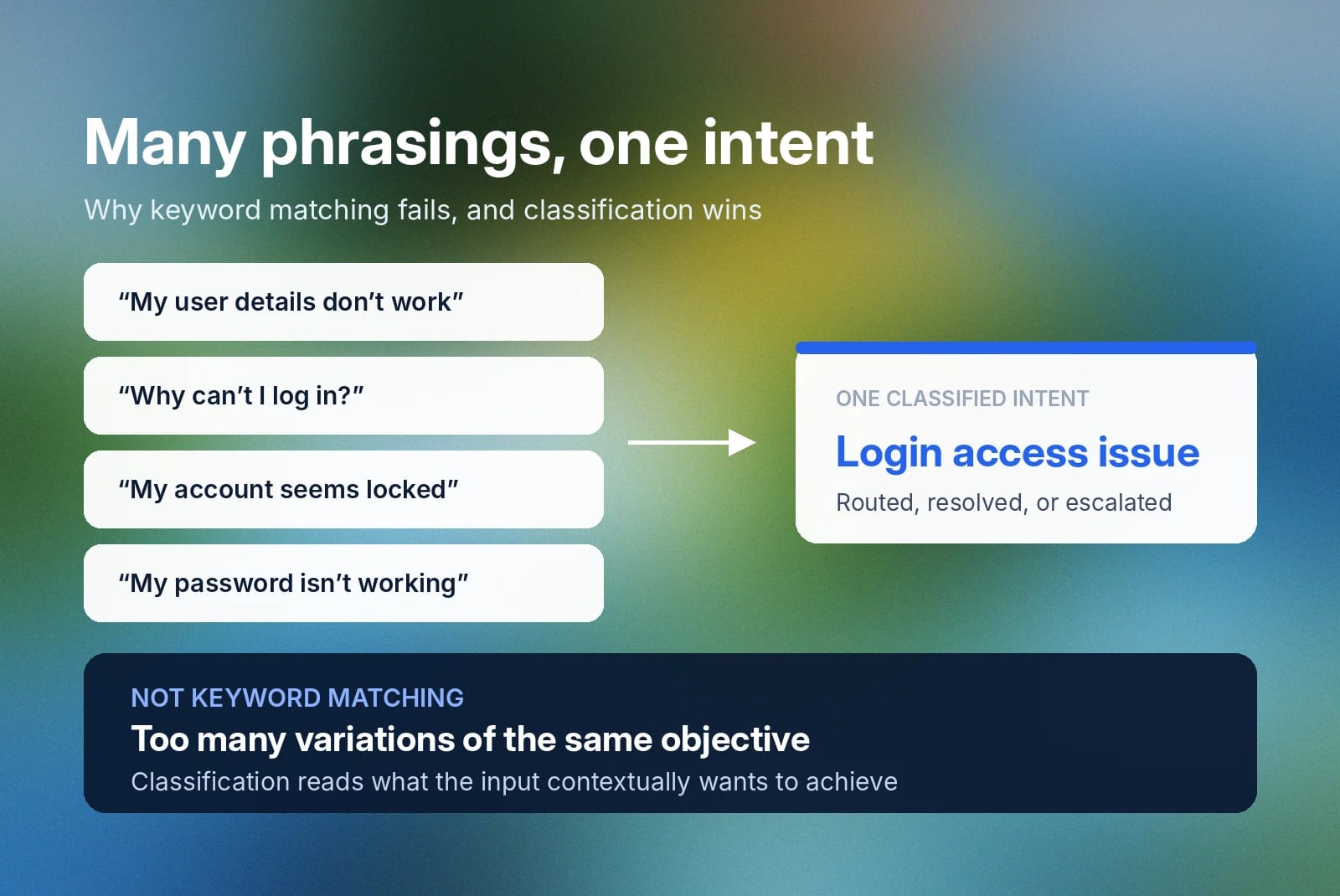
It’s important to note that intent recognition is not simply keyword matching. There are too many linguistic variations of the same objective to use matching. For example, “My user details don’t work,” “Why can’t I log in?”, “My account seems locked,” and “My password isn’t working” are all distinct written variations of the same underlying intent.
By using intent recognition as a function of NLP, artificial intelligence systems can better understand what a user wants from the interaction, allowing them to deliver the best possible experience in every conversation.
How does intent recognition work?
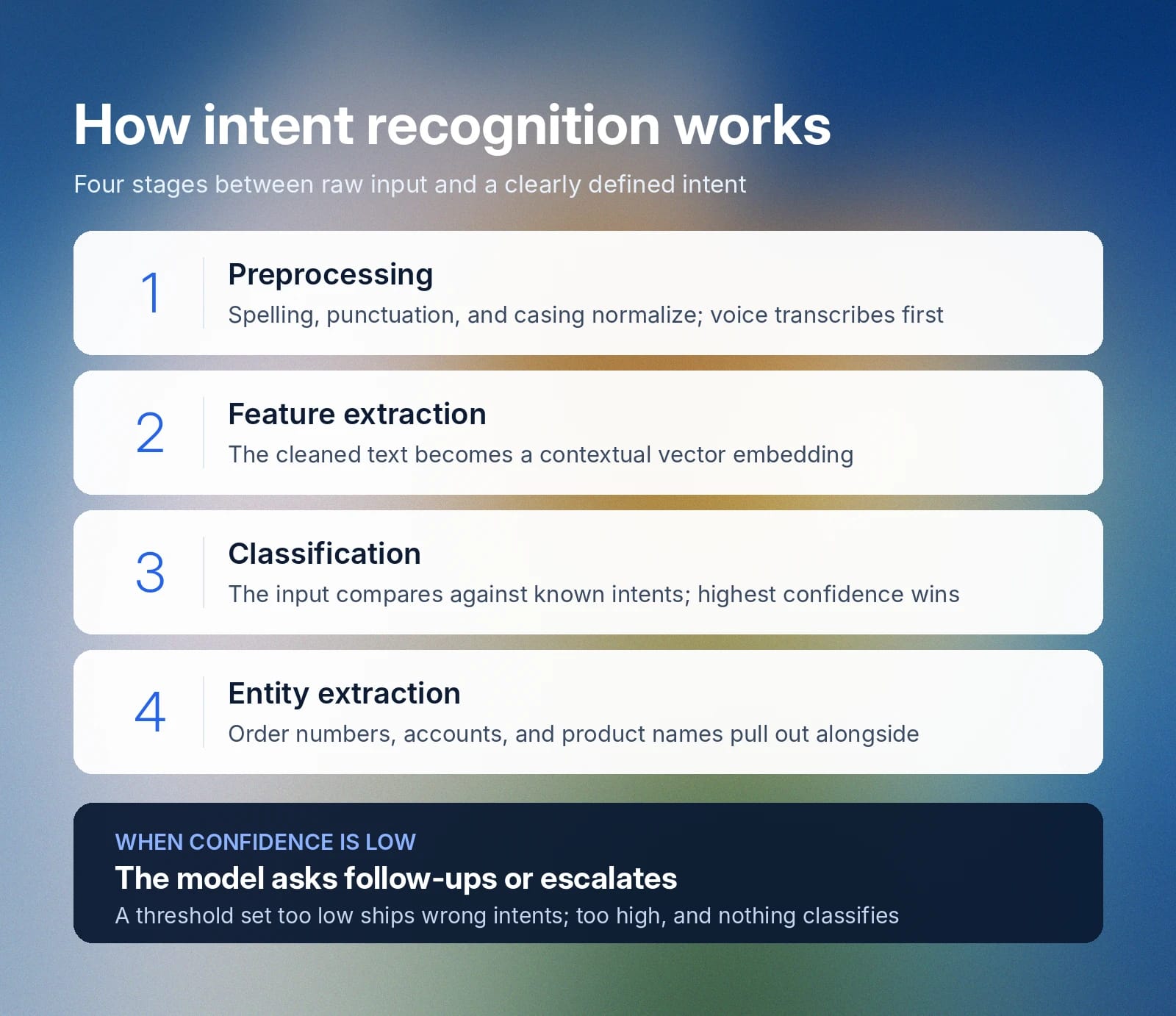
The exact architecture that an AI system uses for intent recognition will depend on the provider. That said, typically the system uses a variation of the same four core stages to transform raw input into a clearly defined intent.
Here are the four stages to intent recognition:
- Preprocessing
- Feature extraction
- Classification
- Entity extraction
Let’s break these down in more detail.
Preprocessing
Input, whether voice or text, needs to be cleaned to ensure the model has a consistent, recognizable format to work with. For text, this would involve correcting spelling mistakes, removing punctuation and capitalization, and then breaking down uncommon or long words into smaller subword units with tokenization. This phase may also remove high-frequency function words like “a” and “the” for clarity, unless, of course, they directly influence the meaning of the sentence.
In automatic speech recognition pipelines, the system first has to transcribe incoming voice data into text, adding another stage to preprocessing before the model can begin to work with the normalized transcript.
Feature extraction
The cleaned text is then transformed into a numerical representation that the software can work with. Feature extraction retains the semantic meaning of a sentence but does so numerically.
The strategies researchers use in this stage have significantly evolved over the past few years. Earlier approaches were to use Bag-of-Words models or Term Frequency-Inverse Document Frequency (TF-IDF) representations to weigh words by how distinctive or frequent they are. Although this gave a rapid result, it failed to capture the nuance of sentences. After all, “I don’t want to cancel” and “I want to cancel” share almost all the same words but are completely different.
Another example that could be difficult with TF-IDF would be "Dog bites cat" against "Cat bites dog", where the meaning completely changes based on very few changes to the sentence.
The more modern approach to feature extraction is to use dense vector representations to create a vector embedding that represents the user’s input. These embeddings relate context through proximal distance, grouping words that have a similar meaning to infer context from that spatial relationship.
Transformer-based encoders take this even further, creating contextual maps where a vector for a word will change depending on the words that surround it. This is essential for any words that are polysemous depending on their context (“please read these instructions,” “I read that article yesterday").
The contextual representation of a sentence is what gives intent recognition systems the ability to understand what a user wants and then classify it in these later stages.
Classification
Armed with a clear representation of an input, a model is then able to compare that input against different known cases of intent, assigning confidence values as it does so. After moving through types of intent, it settles on the one with the highest confidence value.
Some teams will experiment with a confidence threshold for classification. Setting it too low will mean that a fairly inaccurate intent may still be carried forward into the next step. But setting it too high will cause the opposite, with the model being unable to definitively classify intent and move on to the next step.
Fine-tuning your classification model will help find the value that works best for your business.
If the model is unable to identify an intent, it will likely follow up with more questions to the user or escalate to a human agent, if configured to do so.
Entity extraction
We’re framing entity extraction as a separate step, but it really runs concurrently with classification. Entity extraction retrieves details from an input that will be useful in responding later, like order numbers, account details, product names, or other specifics that will help the model execute the request.
The entities extracted in this step help provide user-specific information to successfully execute the request. For example, if classification identifies that a user wants to cancel an order, entity extract will tell the agent which order and which customer account to action.
Intent recognition vs. intent detection
Intent recognition and intent detection are commonly used interchangeably, although they have slightly different meanings. Intent recognition is the overall process of classifying the intent within a user’s request. Intent detection accounts for only the first stage in that process, detecting whether there’s an intent based on the user’s response at all.
In practice, the difference only matters for edge use cases. For example, a customer support agent that receives a question completely unrelated to its learned context may first identify that the intent is not applicable to its knowledge base using intent detection. What it does after that, such as gracefully failing, is determined by intent recognition configuration.
Types of intent
There are as many specific intents as there are questions. Instead of every single possible phraseology of a question requiring a different intent, the system typically first identifies the intent category and then takes action accordingly.
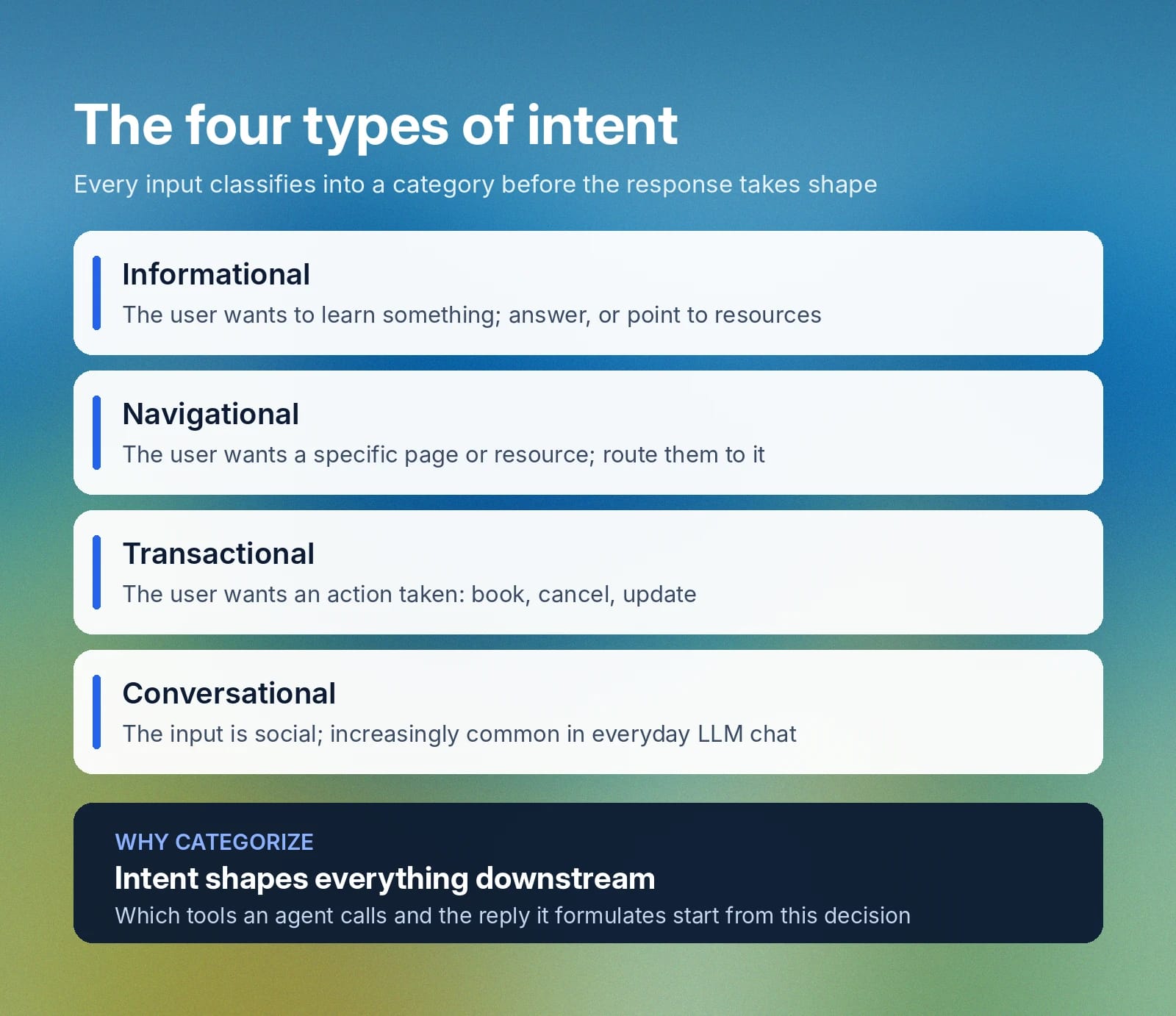
The main types of intent in NLP systems are:
- Informational intent: Describes an input where the main objective of a user is to learn or obtain specific information. The correct response here would be to provide the requested content, either as an explanation or by pointing to the correct resources where the user can find out.
- Navigational intent: Describes when a user wants to find a specific resource or page. The system will categorize this intent and extract entities to then forward them to the right location accordingly.
- Transactional intent: Describes input where a user wants to achieve a specific goal, like booking an appointment or canceling their subscription. Transactional intent is always based upon consequential actions.
- Conversational intent: Describes input that is mainly social instead of one of the other categories. This form of intent is more common now with the rise of widely available LLMs, with some individuals using general-purpose agents as an interface for day-to-day chat.
An LLM can handle all of these types of intent across all of these categories. Regardless, understanding what category of intent an input has will help shape a more accurate response. Everything from which tool calls an agent makes to the exact reply it formulates comes down to first identifying the underlying intent of a user input.
Use cases of intent recognition across industries
Intent recognition is central to any automated response system, as the response has to align with intent for the conversation to make sense.
Here are a few examples of use cases of intent in different industries:
- Customer service: A voice agent uses intent recognition to understand a customer’s spoken request and route them to the right department or resource in response. Misclassification here could result in the customer speaking to the wrong member of staff or having their query go unresolved.
- Healthcare: Intent recognition powers healthcare assistants that manage bookings. Often, industries with higher risk, such as healthcare or finance, will use higher confidence thresholds to avoid any miscategorizations that could lead to critical errors.
- Human resources: An HR conversational assistant could live in internal company docs and guide employees toward the resources they need. For example, an employee could ask about holiday benefits, with the agent understanding the informational intent and surfacing those details from the wider wiki for them.
Across the board, precise intent recognition is the initial factor that propels a successful conversation. If your intent is off, the conversation that follows will be, too.
Challenges in intent recognition
Recognizing the intent of a statement is entirely a linguistic challenge. Meaning changes, words shift function depending on their context, and the same phrase may mean something different depending on how it was said. Especially as intent recognition is increasingly deployed in voice agents, that latter point is extremely important.
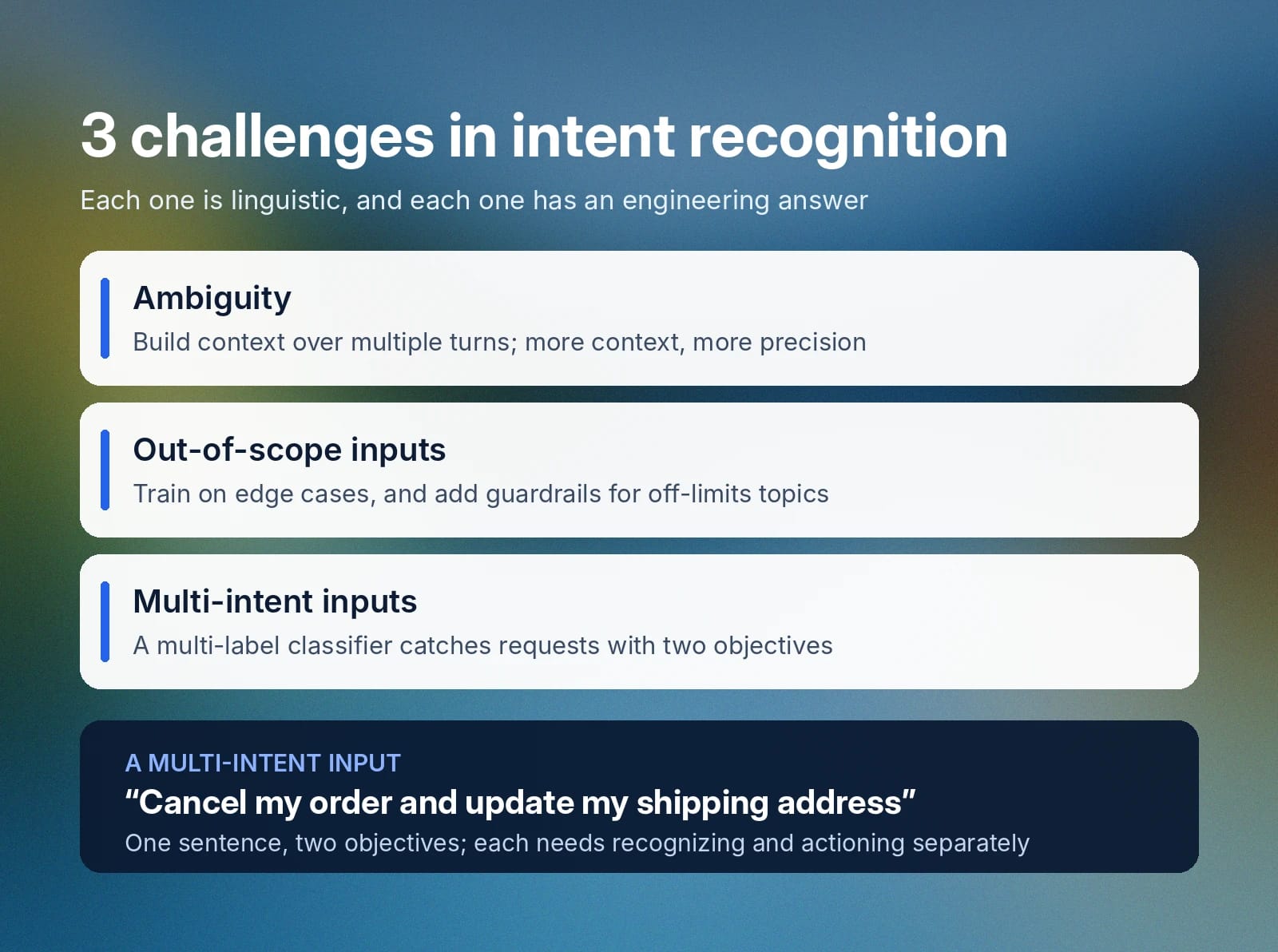
Here are a few of the main challenges in intent recognition and how to solve them:
- Ambiguity: When the same phrase means two different things based on how someone said it, linguistic ambiguity can dilute intent recognition certainty. To get around this, models build context over multiple conversation turns to get a more comprehensive understanding of what someone may want. The more context a model has to use, the more precise it can be when building out its response.
- Conversations beyond the scope of a model: If a user asks a model something that is far beyond the scope of its knowledge, the model may miscategorize the intent to the nearest similar category, leading to an inaccurate response. One solution is to train models on edge use cases to minimize the chance of this happening. Combining this approach with guardrails to prevent certain topics from being breachable in conversation will help mitigate risk here.
- Multi-intent inputs: Naturally, conversation doesn’t always map 1:1 from input to intent. “Would you be able to cancel my order and also update my shipping address for future orders?" has two distinct objectives. Using a multi-label classifier will help to identify any conversation strings that contain more than one intent or objective, boosting accuracy when dealing with multiple underlying desires.
Understanding these challenges and anticipating them allows researchers to put in place factors to mitigate them ahead of time.
Get started with ElevenAgents
In a voice agent, intent recognition helps keep conversational AI systems accurate and customer satisfaction rates high. Repeated mismatches in intent will erode customer trust in your agent and decrease how willing users are to engage with your AI support systems.
ElevenAgents uses intent recognition to precisely understand what a user needs and accommodate them in conversation, routing the interaction correctly, fetching relevant information, or escalating the call accordingly.
Discover more about ElevenAgents or sign up to get started building voice agents that understand what your users want.